X Art Kenna and James Born to Be Wild
| Terence McKenna | |
|---|---|
 | |
| Born | (1946-11-xvi)November xvi, 1946 Paonia, Colorado, U.S. |
| Died | Apr 3, 2000(2000-04-03) (aged 53) San Rafael, California, U.S. |
| Occupation | Author, lecturer |
| Linguistic communication | English |
| Nationality | American |
| Education | BSc in ecology, resource conservation, and shamanism |
| Alma mater | University of California, Berkeley |
| Menstruum | 20th |
| Discipline | Shamanism, ethnobotany, ethnomycology, metaphysics, psychedelic drugs, alchemy |
| Notable works | The Archaic Revival, Nutrient of the Gods, The Invisible Landscape, Psilocybin Magic Mushroom Grower's Guide, Truthful Hallucinations. |
| Spouse | Kathleen Harrison (1975–1992; divorced) |
| Children | Finn McKenna & Klea McKenna |
| Relatives | Dennis McKenna (blood brother) |
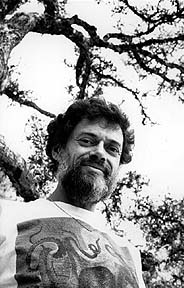
Terence Kemp McKenna (Nov sixteen, 1946 – April 3, 2000) was an American ethnobotanist and mystic who advocated for the responsible utilize of naturally occurring psychedelic plants. He spoke and wrote virtually a variety of subjects, including psychedelic drugs, establish-based entheogens, shamanism, metaphysics, alchemy, linguistic communication, philosophy, civilization, engineering, environmentalism, and the theoretical origins of man consciousness. He was called the "Timothy Leary of the '90s",[one] [2] "i of the leading government on the ontological foundations of shamanism",[iii] and the "intellectual voice of rave civilization".[4]
McKenna formulated a concept nigh the nature of time based on fractal patterns he claimed to have discovered in the I Ching, which he called novelty theory,[3] [v] proposing that this predicted the end of time, and a transition of consciousness in the year 2012.[5] [half dozen] [7] [8] His promotion of novelty theory and its connection to the Maya agenda is credited as one of the factors leading to the widespread beliefs about 2012 eschatology.[9] Novelty theory is considered pseudoscience.[10] [11]
Biography
Early life

Terence McKenna was born and raised in Paonia, Colorado,[five] [12] [13] [ unreliable source? ] with Irish ancestry on his father'southward side of the family unit.[14]
McKenna developed a hobby of fossil-hunting in his youth and from this he acquired a deep scientific appreciation of nature.[15] He also became interested in psychology at a young age, reading Carl Jung's volume Psychology and Alchemy at the historic period of 14.[half dozen] This was the aforementioned age McKenna commencement became enlightened of magic mushrooms, when reading an essay titled "Seeking the Magic Mushroom" which appeared in the May thirteen, 1957 edition of LIFE mag.[16]
At historic period 16 McKenna moved to Los Altos, California to live with family unit friends for a twelvemonth. He finished high school in Lancaster, California.[thirteen] In 1963, he was introduced to the literary earth of psychedelics through The Doors of Perception and Heaven and Hell by Aldous Huxley and certain issues of The Village Vocalism which published manufactures on psychedelics.[3] [13]
McKenna said that one of his early psychedelic experiences with morning glory seeds showed him "that in that location was something there worth pursuing",[13] and in interviews he claimed to take smoked cannabis daily since his teens.[17]
Studying and traveling
In 1965, McKenna enrolled in the University of California, Berkeley and was accustomed into the Tussman Experimental College.[17] While in college in 1967 he began studying shamanism through the report of Tibetan folk faith.[three] [18] That same year, which he called his "opium and kabbala phase",[6] [nineteen] he traveled to Jerusalem where he met Kathleen Harrison, an ethnobotanist who later became his married woman.[6] [17] [19]
In 1969, McKenna traveled to Nepal led by his interest in Tibetan painting and hallucinogenic shamanism.[20] He sought out shamans of the Tibetan Bon tradition, trying to learn more than about the shamanic utilise of visionary plants.[12] During his fourth dimension there, he also studied the Tibetan language[20] and worked as a hashish smuggler,[6] until "one of his Bombay-to-Aspen shipments roughshod into the hands of U. S. Customs."[21] He and then wandered through southeast Asia viewing ruins,[21] and spent time as a professional butterfly collector in Indonesia.[6] [22] [23]
After his mother'due south death[24] from cancer in 1970,[25] McKenna, his brother Dennis, and three friends traveled to the Colombian Amazon in search of oo-koo-hé, a establish grooming containing dimethyltryptamine (DMT).[5] [24] [26] Instead of oo-koo-hé they found fields full of gigantic Psilocybe cubensis mushrooms, which became the new focus of the expedition.[v] [vi] [12] [24] [27] In La Chorrera, at the urging of his blood brother, McKenna was the subject of a psychedelic experiment[5] in which the brothers attempted to bond harmine (harmine is another psychedelic compound they used synergistically with the mushrooms) with their own neural Dna, through the employ of a set specific vocal techniques. They hypothesised this would requite them access to the collective memory of the human species, and would manifest the alchemists' Philosopher'southward Stone which they viewed as a "hyperdimensional union of spirit and thing".[28] McKenna claimed the experiment put him in contact with "Logos": an informative, divine voice he believed was universal to visionary religious feel.[29] McKenna too oft referred to the phonation as "the mushroom", and "the teaching voice" amongst other names.[16] The voice's reputed revelations and his brother's simultaneous peculiar psychedelic experience prompted him to explore the structure of an early grade of the I Ching, which led to his "Novelty Theory".[v] [viii] During their stay in the Amazon, McKenna also became romantically involved with his interpreter, Ev.[30]
In 1972, McKenna returned to U.C. Berkeley to end his studies[17] and in 1975, he graduated with a degree in ecology, shamanism, and conservation of natural resources.[3] [22] [23] In the autumn of 1975, after parting with his girlfriend Ev earlier in the twelvemonth,[31] McKenna began a relationship with his future wife and the female parent of his 2 children, Kathleen Harrison.[eight] [17] [nineteen] [26]
Before long after graduating, McKenna and Dennis published a volume inspired by their Amazon experiences, The Invisible Landscape: Mind, Hallucinogens and the I Ching.[5] [17] [32] The brothers' experiences in the Amazon were the main focus of McKenna's volume True Hallucinations, published in 1993.[12] McKenna also began lecturing[17] locally effectually Berkeley and started actualization on some hugger-mugger radio stations.[half dozen]
Psilocybin mushroom cultivation

Psilocybin: Magic Mushroom Grower's Guide (1986 revised edition)
McKenna, forth with his brother Dennis, developed a technique for cultivating psilocybin mushrooms using spores they brought to America from the Amazon.[16] [26] [27] [31] In 1976, the brothers published what they had learned in the book Psilocybin: Magic Mushroom Grower'southward Guide, nether the pseudonyms "O.T. Oss" and "O.Due north. Oeric".[12] [33] McKenna and his brother were the first to come up with a reliable method for cultivating psilocybin mushrooms at home.[12] [17] [26] [27] As ethnobiologist Jonathan Ott explains, "[the] authors adapted San Antonio's technique (for producing edible mushrooms past casing mycelial cultures on a rye grain substrate; San Antonio 1971) to the production of Psilocybe [Stropharia] cubensis. The new technique involved the utilise of ordinary kitchen implements, and for the first time the layperson was able to produce a potent entheogen in his [or her] ain habitation, without access to sophisticated engineering, equipment, or chemical supplies."[34] When the 1986 revised edition was published, the Magic Mushroom Grower's Guide had sold over 100,000 copies.[12] [33] [35]
Mid- to later life
Public speaking
In the early 1980s, McKenna began to speak publicly on the topic of psychedelic drugs, becoming one of the pioneers of the psychedelic movement.[36] His main focus was on the establish-based psychedelics such every bit psilocybin mushrooms (which were the catalyst for his career),[12] ayahuasca, cannabis, and the plant derivative DMT.[6] He conducted lecture tours and workshops[6] promoting natural psychedelics as a mode to explore universal mysteries, stimulate the imagination, and re-found a harmonious relationship with nature.[37] Though associated with the New Age and Homo Potential Movements, McKenna himself had trivial patience for New Age sensibilities.[three] [7] [8] [38] He repeatedly stressed the importance and primacy of the "felt presence of straight experience", as opposed to dogma.[39]
In addition to psychedelic drugs, McKenna spoke on a broad array of subjects[26] including; shamanism; metaphysics; alchemy; language; culture; self-empowerment; environmentalism, techno-paganism; artificial intelligence; development; extraterrestrials; scientific discipline and scientism; the Web; virtual reality (which he saw every bit a way to artistically communicate the feel of psychedelics); and artful theory, specifically about art/visual feel as information representing the significance of hallucinatory visions experienced under the influence of psychedelics.
It'south clearly a crisis of two things: of consciousness and workout. These are the two things that the psychedelics set on. We have the technological ability, the engineering skills to salve our planet, to cure illness, to feed the hungry, to end war; But we lack the intellectual vision, the power to alter our minds. We must decondition ourselves from 10,000 years of bad behavior. And, it's not easy.
—Terence McKenna, "This World...and Its Double", [40]
McKenna soon became a fixture of popular counterculture[5] [vi] [37] with Timothy Leary in one case introducing him as "one of the 5 or vi about important people on the planet"[41] and with comedian Bill Hicks' referencing him in his stand-upwards human activity[42] and building an unabridged routine around his ideas.[26] McKenna also became a popular personality in the psychedelic rave/dance scene of the early 1990s,[22] [43] with frequent spoken word performances at raves and contributions to psychedelic and goa trance albums by The Shamen,[seven] [26] [37] Spacetime Continuum, Alien Project, Capsula, Entheogenic, Zuvuya, Shpongle, and Shakti Twins. In 1994 he appeared as a speaker at the Starwood Festival, documented in the book Tripping by Charles Hayes.[44]
McKenna published several books in the early on-to-mid-1990s including: The Archaic Revival; Food of the Gods; and True Hallucinations.[6] [12] [22] Hundreds of hours of McKenna's public lectures were recorded either professionally or bootlegged and have been produced on cassette tape, CD and MP3.[26] Segments of his talks have gone on to be sampled by many musicians and DJ'due south.[4] [26]
McKenna was a colleague and close friend of chaos mathematician Ralph Abraham, and author and biologist Rupert Sheldrake. He conducted several public and many individual debates with them from 1982 until his death.[45] [46] [47] These debates were known as trialogues and some of the discussions were afterward published in the books: Trialogues at the Edge of the Westward and The Evolutionary Mind.[three] [45]
Botanical Dimensions

In 1985, McKenna founded Botanical Dimensions with his then-wife, Kathleen Harrison.[22] [48] Botanical Dimensions is a nonprofit ethnobotanical preserve on the Large Island of Hawaii,[3] established to collect, protect, propagate, and understand plants of ethno-medical significance and their lore, and appreciate, study, and educate others well-nigh plants and mushrooms felt to be significant to cultural integrity and spiritual well-being.[49] The 19-acre (7.seven ha) botanical garden[three] is a repository containing thousands of plants that accept been used by indigenous people of the tropical regions, and includes a database of information related to their purported healing backdrop.[l] McKenna was involved until 1992, when he retired from the project,[48] following his and Kathleen's divorce earlier in the yr.[17] Kathleen still manages Botanical Dimensions as its president and projects director.[49]
Later on their divorce, McKenna moved to Hawaii permanently, where he built a modernist house[17] and created a cistron bank of rare plants about his home.[22] Previously, he had split his fourth dimension between Hawaii and Occidental, CA.

Terence McKenna during a panel discussion at the 1999 AllChemical Arts Conference, held at Kona, Hawaii.
Expiry
McKenna was a longtime sufferer of migraines, merely on 22 May 1999 he began to have unusually extreme and painful headaches. He then complanate due to a brain seizure.[27] McKenna was diagnosed with glioblastoma multiforme, a highly ambitious form of brain cancer.[7] [12] [27] For the next several months he underwent various treatments, including experimental gamma pocketknife radiations treatment. According to Wired magazine, McKenna was worried that his tumor may have been caused past his psychedelic drug utilise, or his 35 years of daily cannabis smoking; nonetheless, his doctors assured him there was no causal relation.[27]
In late 1999, McKenna described his thoughts concerning his impending death to interviewer Erik Davis:
I always thought death would come on the pike in a few horrifying moments, then yous'd have no fourth dimension to sort information technology out. Having months and months to look at information technology and think about it and talk to people and hear what they have to say, it'south a kind of blessing. It's certainly an opportunity to grow up and become a grip and sort it all out. Just being told by an unsmiling guy in a white glaze that you're going to be dead in four months definitely turns on the lights. ... It makes life rich and poignant. When it beginning happened, and I got these diagnoses, I could see the light of eternity, à la William Blake, shining through every leafage. I mean, a bug walking across the ground moved me to tears.[51]
McKenna died on April 3, 2000, at the age of 53.[7] [eight] [17]
Library fire and insect collection
On February vii, 2007, McKenna'south library of over 3000 rare books and personal notes was destroyed in a burn at the Esalen Constitute in Large Sur, California. An alphabetize of McKenna'southward library was made by his brother Dennis.[52] [53] His daughter, the creative person and photographer Klea McKenna, later on preserved his insect collection, turning it into a gallery installation, and then publishing it in book form as The Butterfly Hunter, featuring her selected photos of 122 insects – 119 butterflies/moths and three beetles or protrude-like insects – from a gear up of over 2000 he collected between 1969 and 1972, as well as maps showing his collecting routes through the rainforests of Southeast Asia and Southward America.[54] McKenna had intensively studied Lepidoptera and entomology in the 1960s, and as office of his studies hunted for butterflies primarily in Colombia and Indonesia. McKenna's insect collection was consequent with his interest in Victorian-era explorers and naturalists, and his worldview based on shut observation of nature. In the 1970s, when he was still collecting, he became quite dainty and guilt-ridden about the necessity of killing collywobbles in social club to collect and classify them, and that's what led him to stop his entomological studies, according to his daughter.[54]
Thought
Psychedelics
Terence McKenna advocated the exploration of altered states of heed via the ingestion of naturally occurring psychedelic substances;[5] [32] [43] for example, and in particular, as facilitated by the ingestion of loftier doses of psychedelic mushrooms,[26] [55] ayahuasca, and DMT,[6] which he believed was the embodiment of the psychedelic experience. He was less enthralled with synthetic drugs,[6] stating, "I remember drugs should come from the natural world and be employ-tested by shamanically orientated cultures ... one cannot predict the long-term effects of a drug produced in a laboratory."[iii]
McKenna always stressed the responsible employ of psychedelic plants, proverb:
"Experimenters should be very conscientious. One must build up to the experience. These are bizarre dimensions of extraordinary ability and beauty. There is no set rule to avoid being overwhelmed, merely move advisedly, reflect a great deal, and always try to map experiences back onto the history of the race and the philosophical and religious accomplishments of the species. All the compounds are potentially unsafe, and all compounds, at sufficient doses or repeated over time, involve risks. The library is the kickoff place to go when looking into taking a new compound."[56]
He besides recommended, and often spoke of taking, what he called "heroic doses",[32] which he defined as five grams of dried psilocybin mushrooms,[6] [57] taken alone, on an empty stomach, in silent darkness, and with optics closed.[26] [27] He believed that when taken this way i could wait a profound visionary experience,[26] believing information technology is only when "slain" by the power of the mushroom that the message becomes clear.[55]
Although McKenna avoided giving his allegiance to any one interpretation (office of his rejection of monotheism), he was open to the idea of psychedelics as being "trans-dimensional travel". He proposed that DMT sent i to a "parallel dimension"[viii] and that psychedelics literally enabled an individual to encounter "college dimensional entities",[58] or what could be ancestors, or spirits of the Earth,[59] saying that if you can trust your own perceptions it appears that you are inbound an "environmental of souls".[lx] McKenna also put forrard the thought that psychedelics were "doorways into the Gaian mind",[43] [61] suggesting that "the planet has a kind of intelligence, information technology can actually open a channel of communication with an private human existence" and that the psychedelic plants were the facilitators of this advice.[62] [63]
Machine elves
McKenna spoke of hallucinations while on DMT in which he claims to have met intelligent entities he described equally, "self-transforming car elves".[three] [8] [64] [65]
Psilocybin panspermia speculation
In a more radical version of biophysicist Francis Crick's hypothesis of directed panspermia, McKenna speculated on the idea that psilocybin mushrooms may exist a species of loftier intelligence,[3] which may have arrived on this planet as spores migrating through space[8] [66] and which are attempting to found a symbiotic human relationship with human beings. He postulated that "intelligence, not life, just intelligence may accept come here [to Earth] in this spore-bearing life course". He said, "I think that theory will probably be vindicated. I recall in a hundred years if people practice biology they will call up it quite silly that people one time thought that spores could non be diddled from one star system to another by cosmic radiation pressure," and likewise believed that "few people are in a position to judge its extraterrestrial potential, because few people in the orthodox sciences have ever experienced the full spectrum of psychedelic effects that are unleashed."[3] [7] [eighteen]
Opposition to organized religion
McKenna was opposed to Christianity[67] and most forms of organized religion or guru-based forms of spiritual awakening, favouring shamanism, which he believed was the broadest spiritual paradigm bachelor, stating that:
What I think happened is that in the globe of prehistory all organized religion was experiential, and information technology was based on the pursuit of ecstasy through plants. And at some time, very early, a group interposed itself between people and directly experience of the 'Other.' This created hierarchies, priesthoods, theological systems, castes, ritual, taboos. Shamanism, on the other hand, is an experiential scientific discipline that deals with an area where we know nothing. It is important to remember that our epistemological tools have adult very unevenly in the West. Nosotros know a tremendous amount well-nigh what is going on in the heart of the atom, but we know admittedly nothing about the nature of the listen.[68]
Technological singularity
During the last years of his life and career, McKenna became very engaged in the theoretical realm of technology. He was an early proponent of the technological singularity[viii] and in his last recorded public talk, Psychedelics in the age of intelligent machines, he outlined ties between psychedelics, computation engineering, and humans.[69] He also became enamored with the Internet, calling information technology "the birth of [the] global mind",[17] believing it to be a place where psychedelic culture could flourish.[27]
Admired writers
Either philosophically or religiously, he expressed admiration for Marshall McLuhan, Alfred North Whitehead, Pierre Teilhard de Chardin, Carl Jung, Plato, Gnostic Christianity, and Alchemy, while regarding the Greek philosopher Heraclitus as his favorite philosopher.[seventy]
McKenna likewise expressed admiration for the works of writers including Aldous Huxley,[iii] James Joyce, whose book Finnegans Wake he called "the quintessential work of art, or at to the lowest degree piece of work of literature of the 20th century,"[71] scientific discipline fiction writer Philip Grand. Dick, who he described as an "incredible genius,"[72] fabulist Jorge Luis Borges, with whom McKenna shared the belief that "scattered through the ordinary world there are books and artifacts and perhaps people who are like doorways into impossible realms, of impossible and contradictory truth"[viii] and Vladimir Nabokov; McKenna once said that he would take get a Nabokov lecturer if he had never encountered psychedelics.
"Stoned ape" theory of human evolution
In his 1992 book Food of the Gods, McKenna proposed that the transformation from humans' early ancestors Human erectus to the species Human being sapiens mainly had to exercise with the add-on of the mushroom Psilocybe cubensis in the diet,[26] [73] [74] an event that according to his theory took place in most 100,000 BCE (which is when he believed that the species diverged from the genus Homo).[22] [75] McKenna based his theory on the main effects, or alleged effects, produced by the mushroom[3] while citing studies by Roland Fischer et al. from the belatedly 1960s to early 1970s.[76] [77]
McKenna stated that, due to the desertification of the African continent at that time, human forerunners were forced from the increasingly shrinking tropical canopy into search of new nutrient sources.[6] He believed they would accept been following big herds of wild cattle whose dung harbored the insects that, he proposed, were undoubtedly function of their new diet, and would have spotted and started eating Psilocybe cubensis, a dung-loving mushroom oft found growing out of cowpats.[half-dozen] [7] [43] [78]

Psilocybe cubensis: the psilocybin-containing mushroom central to McKenna's "stoned ape" theory of human development.
McKenna's hypothesis was that low doses of psilocybin improve visual vigil, particularly edge detection, meaning that the presence of psilocybin in the diet of early on pack hunting primates caused the individuals who were consuming psilocybin mushrooms to be amend hunters than those who were not, resulting in an increased food supply and in plow a higher rate of reproductive success.[3] [vii] [16] [26] [43] Then at slightly higher doses, he contended, the mushroom acts to sexually arouse, leading to a higher level of attending, more energy in the organism, and potential erection in the males,[iii] [7] rendering information technology fifty-fifty more evolutionarily beneficial, as it would event in more offspring.[26] [43] [74] At even higher doses, McKenna proposed that the mushroom would take acted to "deliquesce boundaries," promoting community bonding and group sexual activities.[12] [43] Consequently, there would be a mixing of genes, greater genetic diversity, and a communal sense of responsibility for the grouping offspring.[79] At these higher doses, McKenna also argued that psilocybin would be triggering activity in the "language-forming region of the brain", manifesting equally music and visions,[3] thus catalyzing the emergence of language in early on hominids past expanding "their arboreally evolved repertoire of troop signals."[7] [26] He also pointed out that psilocybin would dissolve the ego and "religious concerns would be at the forefront of the tribe's consciousness, simply because of the ability and strangeness of the experience itself."[43] [79]
Therefore, according to McKenna, access to and ingestion of mushrooms was an evolutionary advantage to humans' omnivorous hunter-gatherer ancestors,[26] [78] as well providing humanity's first religious impulse.[78] [lxxx] He believed that psilocybin mushrooms were the "evolutionary catalyst"[iii] from which language, projective imagination, the arts, religion, philosophy, science, and all of homo culture sprang.[7] [8] [27] [78]
McKenna's hypothesis concerning the influence of psilocybin mushrooms on human evolution is known as "the 'stoned ape' theory."[xvi] [43] [73]
In 2019 McKenna's theory was supported by the mycologist Paul Stamets.[ commendation needed ]
Criticism
McKenna's "stoned ape" theory has not received attending from the scientific community and has been criticized for a relative lack of citation to any of the paleoanthropological show informing our understanding of homo origins. His ideas regarding psilocybin and visual acuity have been criticized as misrepresentations of Fischer et al.'s findings, who published studies about visual perception in terms of various specific parameters, non acuity. Criticism has as well been expressed due to the fact that in a carve up study on psilocybin induced transformation of visual infinite. Fischer et al. stated that psilocybin "may not be conducive to the survival of the organism". At that place is also a lack of scientific show that psilocybin increases sexual arousal, and even if information technology does, information technology does non necessarily entail an evolutionary advantage.[81] Others accept pointed to civilisations such every bit the Aztecs, who used psychedelic mushrooms (at least amid the Priestly class), that didn't reverberate McKenna'south model of how psychedelic-using cultures would behave, for case, by carrying out human sacrifice.[12] Although, it has been noted that psilocybin usage by the Aztec civilisation is far removed from the type of usage on which McKenna was speculating.[43] There are too examples of Amazonian tribes such as the Jivaro and the Yanomami who utilize ayahuasca ceremoniously and who are known to engage in violent behaviour. This, it has been argued, indicates the use of psychedelic plants does not necessarily suppress the ego and create harmonious societies.[43]
Archaic revival
1 of the main themes running through McKenna's work, and the championship of his second book, was the idea that Western civilisation was undergoing what he called an "archaic revival".[three] [26] [82]
His notion was that Western society has become "sick" and is undergoing a "healing procedure", in the same way that the human body begins to produce antibodies when it feels itself to be sick, humanity as a collective whole (in the Jungian sense) was creating "strategies for overcoming the condition of dis-ease" and trying to cure itself, by what he termed equally "a reversion to archaic values." McKenna pointed to phenomena including surrealism, abstract expressionism, body piercing and tattooing, psychedelic drug apply, sexual permissiveness, jazz, experimental dance, rave civilization, stone and roll and ending theory, amongst others, every bit his evidence that this process was underway.[83] [84] [85] This idea is linked to McKenna's "stoned ape" theory of human evolution, with him viewing the "primitive revival" every bit an impulse to return to the symbiotic and blissful human relationship he believed humanity once had with the psilocybin mushroom.[26]
In differentiating his idea from the "New Historic period", a term that he felt trivialized the significance of the adjacent phase in human evolution, McKenna stated that: "The New Historic period is substantially humanistic psychology '80s-style, with the addition of neo-shamanism, channeling, crystal and herbal healing. The archaic revival is a much larger, more global phenomenon that assumes that we are recovering the social forms of the late neolithic, and reaches far back in the 20th century to Freud, to surrealism, to abstract expressionism, fifty-fifty to a miracle similar National Socialism which is a negative forcefulness. But the stress on ritual, on organized activity, on race/ancestor-consciousness – these are themes that have been worked out throughout the entire 20th century, and the archaic revival is an expression of that."[3] [eighteen]
Novelty theory and Timewave Zero
Novelty theory is a pseudoscientific idea[x] [11] that purports to predict the ebb and menstruum of novelty in the universe as an inherent quality of time, proposing that fourth dimension is not a constant merely has various qualities disposed toward either "habit" or "novelty".[5] Addiction, in this context, can exist idea of every bit entropic, repetitious, or bourgeois; and novelty as artistic, disjunctive, or progressive phenomena.[eight] McKenna's idea was that the universe is an engine designed for the production and conservation of novelty and that as novelty increases, so does complication. With each level of complication achieved condign the platform for a further rise into complication.[eight]

The basis of the theory was originally conceived in the mid-1970s afterwards McKenna's experiences with psilocybin mushrooms at La Chorrera in the Amazon led him to closely study the King Wen sequence of the I Ching.[5] [6] [27]
In Asian Taoist philosophy the concept of opposing phenomena is represented by the yin and yang. Both are always nowadays in everything, nevertheless the amount of influence of each varies over time. The individual lines of the I Ching are made up of both Yin (cleaved lines) and Yang (solid lines).
When examining the King Wen sequence of the 64 hexagrams, McKenna noticed a blueprint. He analysed the "degree of difference" between the hexagrams in each successive pair and claimed he plant a statistical anomaly, which he believed suggested that the King Wen sequence was intentionally constructed,[v] with the sequence of hexagrams ordered in a highly structured and artificial mode, and that this pattern codification the nature of time's flow in the world.[28] With the degrees of difference every bit numerical values, McKenna worked out a mathematical wave form based on the 384 lines of modify that brand up the 64 hexagrams. He was able to graph the data and this became the Novelty Fourth dimension Moving ridge.[5]
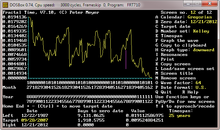
A screenshot of the Timewave Zero software (written by Peter J. Meyer) showing the timewave for the 25 years preceding a zero date of December 21, 2012.
Peter J. Meyer (Peter Johann Gustav Meyer) (born 1946), in collaboration with McKenna, studied and improved the foundations of novelty theory, working out a mathematical formula and developing the Timewave Nil software (the original version of which was completed past July 1987),[86] enabling them to graph and explore its dynamics on a figurer.[5] [seven] The graph was fractal, information technology exhibited a design in which a given small department of the moving ridge was establish to be identical in form to a larger section of the wave.[3] [5] McKenna called this fractal modeling of time "temporal resonance", proposing it implied that larger intervals, occurring long ago, contained the same amount of data every bit shorter, more recent, intervals.[5] [87] He suggested the upwards-and-downwardly pattern of the wave shows an ongoing wavering between addiction and novelty respectively. With each successive iteration trending, at an increasing level, towards infinite novelty. So according to novelty theory, the blueprint of time itself is speeding up, with a requirement of the theory existence that infinite novelty will be reached on a specific date.[3] [five]
McKenna suspected that notable events in history could be identified that would help him locate the time wave's end appointment[5] and attempted to find the best-fit placement when matching the graph to the data field of man history.[7] The last harmonic of the wave has a duration of 67.29 years.[88] Population growth, summit oil, and pollution statistics were some of the factors that pointed him to an early on twenty-first century end engagement and when looking for an extremely novel outcome in human history every bit a signal that the final stage had begun McKenna picked the dropping of the atomic bomb on Hiroshima.[5] [88] This worked out to the graph reaching nix in mid-November 2012. When he afterward discovered that the finish of the 13th baktun in the Maya calendar had been correlated by Western Maya scholars as December 21, 2012,[a] he adopted their end appointment instead.[5] [94] [b]
McKenna saw the universe, in relation to novelty theory, every bit having a teleological attractor at the finish of time,[5] which increases interconnectedness and would eventually achieve a singularity of infinite complication. He also oftentimes referred to this as "the transcendental object at the terminate of time."[5] [vii] When describing this model of the universe he stated that: "The universe is not beingness pushed from behind. The universe is being pulled from the future toward a goal that is equally inevitable as a marble reaching the bottom of a bowl when you release it up nearly the rim. If yous do that, you know the marble volition roll down the side of the bowl, down, downwardly, downwards – until eventually it comes to remainder at the everyman energy state, which is the bottom of the basin. That'southward precisely my model of human history. I'm suggesting that the universe is pulled toward a complex attractor that exists alee of united states in time, and that our ever-accelerating speed through the phenomenal earth of connectivity and novelty is based on the fact that we are now very, very shut to the attractor."[95] Therefore, according to McKenna's final interpretation of the information and positioning of the graph, on December 21, 2012, we would take been in the unique position in fourth dimension where maximum novelty would be experienced.[3] [v] [27] An upshot he described as a "concrescence",[12] a "tightening 'roll'" with everything flowing together. Speculating that "when the laws of physics are obviated, the universe disappears, and what is left is the tightly bound plenum, the monad, able to express itself for itself, rather than only able to bandage a shadow into physis as its reflection...It will be the entry of our species into 'hyperspace', but it will appear to be the end of physical laws, accompanied by the release of the mind into the imagination."[96]
Novelty theory is considered to be pseudoscience.[10] [11] Among the criticisms are the utilise of numerology to derive dates of important events in world history,[11] the arbitrary rather than calculated end date of the fourth dimension wave[26] and the apparent adjustment of the eschaton from November 2012 to December 2012 in order to coincide with the Maya calendar. Other purported dates do not fit the actual time frames: the appointment claimed for the emergence of Homo sapiens is inaccurate by 70,000 years, and the beingness of the ancient Sumer and Egyptian civilisations contradict the appointment he gave for the beginning of "historical time". Some projected dates have been criticised for having seemingly arbitrary labels, such as the "height of the age of mammals"[11] and McKenna's analysis of historical events has been criticised for having a eurocentric and cultural bias.[6] [26]
The Watkins Objection
The British mathematician Matthew Watkins of Exeter University conducted a mathematical analysis of the Fourth dimension Moving ridge, and claimed there were various mathematical flaws in its construction.[26]
Critical reception
1 expert on drug handling attacked McKenna for popularizing "dangerous substances." Judy Corman, vice president of Phoenix House of New York, a drug handling center, said in a letter to The New York Times in 1993: "Surely the fact that Terence McKenna says that the psilocybin mushroom 'is the megaphone used past an alien, intergalactic Other to communicate with mankind' is enough for us to wonder if taking LSD has done something to his mental faculties."[17]
"I suffered hallucinatory agonies of my own while reading his shrilly ecstatic prose," Peter Conrad wrote in The New York Times in a 1993 review of McKenna'southward book True Hallucinations.[17]
Harvard Academy biologist Richard Evans Schultes wrote in American Scientist, in a 1993 review of McKenna's Food of the Gods, that the book was "a masterpiece of research and writing" and that it "should be read by every specialist working in the multifarious fields involved with the use of psychoactive drugs." Concluding that, "[i]t is, without question, destined to play a major role in our future considerations of the role of the ancient apply of psychoactive drugs, the historical shaping of our modern concerns about drugs and possibly about human being's want for escape from reality with drugs."[97]
John Horgan, in a 2012 blog postal service for Scientific American, too commented that Food of the Gods was "a rigorous statement...that mind-expanding plants and fungi catalyzed the transformation of our brutish ancestors into cultured modern humans."[8]
"To write him off as a crazy hippie is a rather lazy arroyo to a homo not only full of fascinating ideas but also blessed with a sense of humour and cocky-parody," Tom Hodgkinson wrote in The New Statesman and Guild in 1994.[17]
Mark Jacobson said of Truthful Hallucinations, in a 1992 issue of Esquire Magazine that, "it would be hard to find a drug narrative more compellingly perched on a baroquely romantic limb than this passionate Tom-and-Huck-ride-groovy-mother-river-saga of brotherly bonding," adding "put simply, Terence is a hoot!"[6]
Wired chosen him a "charismatic talking caput" who was "brainy, eloquent, and hilarious"[27] and Jerry Garcia of the Grateful Dead as well said that he was "the but person who has made a serious effort to objectify the psychedelic feel."[17]
Bibliography
- McKenna, Dennis; McKenna, Terence (1975). The Invisible Landscape: Heed, Hallucinogens, and the I Ching. New York: Seabury. ISBN978-0-8164-9249-7.
- McKenna, Dennis; McKenna, Terence (1976). Psilocybin: Magic Mushroom Grower's Guide. Under the pseudonyms OT Oss and ON Oeric. Berkeley, CA: And/Or Press. ISBN978-0-915904-13-6.
- McKenna, Terence (1992a). The Archaic Revival: Speculations on Psychedelic Mushrooms, the Amazon, Virtual Reality, UFOs, Development, Shamanism, the Rebirth of the Goddess, and the End of History. San Francisco: Harper San Francisco. ISBN978-0-06-250613-nine.
- McKenna, Terence (1992b). Food of the Gods: The Search for the Original Tree of Knowledge – A Radical History of Plants, Drugs, and Human Evolution. New York: Runted. ISBN978-0-553-07868-8.
- McKenna, Terence (1992). Synesthesia. Illustrated by Ely, Timothy C. New York: Granary Books. OCLC 30473682.
- Abraham, Ralph H.; McKenna, Terence; Sheldrake, Rupert (1992). Trialogues at the Edge of the W: Chaos, Inventiveness, and the Resacralization of the World. Forward by Houston, Jean. Bear & Company. ISBN978-0-939680-97-9.
- McKenna, Terence (1993). True Hallucinations: Existence an Business relationship of the Author's Extraordinary Adventures in the Devil'south Paradise. San Francisco: Harper San Francisco. ISBN978-0-06-250545-3.
- Abraham, Ralph H.; McKenna, Terence; Sheldrake, Rupert (1998). The Evolutionary Mind: Conversations on Science, Imagination & Spirit. Monkfish Book Publishing. ISBN978-0-9749359-7-3.
Spoken word
- History Ends in Light-green: Gaia, Psychedelics and the Primitive Revival, six audiocassette set, Mystic Fire audio, 1993, ISBN 978-1-56176-907-0 (recorded at the Esalen Institute, 1989)
- TechnoPagans at the End of History (transcription of rap with Marker Pesce from 1998)
- Psychedelics in the Age of Intelligent Machines (1999) (DVD) HPX/SurrealStudio
- Conversations on the Edge of Magic (1994) (CD & Cassette) ACE
- Rap-Dancing into the Third Millennium (1994) (Cassette) (Re-issued on CD as The Quintessential Hallucinogen) ACE
- Packing For the Long Foreign Trip (1994) (Sound Cassette) ACE
- Global Perspectives and Psychedelic Poetics (1994) (Cassette) Audio Horizons Audio-Video, Inc.
- The Search for the Original Tree of Knowledge (1992) (Cassette) Sounds Truthful
- The Psychedelic Social club (DVD & Video Cassette) Sound Photosynthesis
- True Hallucinations Workshop (Audio/Video Cassette) Audio Photosynthesis
- The Vertigo at History'due south Edge: Who Are We? Where Have We Come From? Where Are We Going? (DVD & Video/Sound Cassette) Sound Photosynthesis
- Ethnobotany and Shamanism (DVD & Video/Audio Cassette) Sound Photosynthesis
- Shamanism, Symbiosis and Psychedelics Workshop (Audio/Video Cassette) Audio Photosynthesis
- Shamanology (Sound Cassette) Audio Photosynthesis
- Shamanology of the Amazon (w/ Nicole Maxwell) (Audio/Video Cassette) Sound Photosynthesis
- Beyond Psychology (1983) (Audio Cassette) Sound Photosynthesis
- Agreement & the Imagination in the Calorie-free of Nature Parts 1 & 2 (DVD & Video/Audio Cassette) Sound Photosynthesis
- Ethnobotany (a consummate grade given at The California Institute of Integral Studies) (Sound Cassette) Sound Photosynthesis
- Non-ordinary States of Reality Through Vision Plants (Sound Cassette) Sound Photosynthesis
- Listen & Time, Spirit & Thing: The Complete Weekend in Santa Fe (Audio/Video Cassette) Sound Photosynthesis
- Forms and Mysteries: Morphogenetic Fields and Psychedelic Experiences (west/ Rupert Sheldrake) (DVD & Video/Audio Cassette) Sound Photosynthesis
- UFO: The Inside Outsider (DVD & Video/Audio Cassette) Sound Photosynthesis
- A Calendar for The Goddess (DVD & Video/Audio Cassette) Sound Photosynthesis
- A Magical Journeying: Including Hallucinogens and Culture, Time and The I Ching, and The Homo Future (Video Cassette) TAP/Sound Photosynthesis
- Aliens and Archetypes (Video Cassette) TAP/Audio Photosynthesis
- Angels, Aliens and Archetypes 1987 Symposium: Shamanic Approaches to the UFO, and Fairmont Banquet Talk (DVD & Video/Audio Cassette) Audio Photosynthesis
- Botanical Dimensions (Audio Cassette) Audio Photosynthesis
- Conference on Botanical Intelligence (w/ Joan Halifax, Andy Weil, & Dennis McKenna) (Sound Cassette) Sound Photosynthesis
- Coping With Gaia'due south Midwife Crisis (Sound Cassette) Audio Photosynthesis
- Dreaming Awake at the Terminate of Time (DVD & Video/Sound Cassette) Sound Photosynthesis
- Evolving Times (DVD, CD & Video/Audio Cassette) Sound Photosynthesis
- Nutrient of the Gods (Audio/Video Cassette) Sound Photosynthesis
- Food of the Gods 2: Drugs, Plants and Destiny (Video Cassette) Sound Photosynthesis
- Hallucinogens in Shamanism & Anthropology at Bridge Psychedelic Conf.1991 (w/ Ralph Metzner, Marlene Dobkin De Rios, Allison Kennedy & Thomas Pinkson) (Audio Cassette) Sound Photosynthesis
- Finale – Bridge Psychedelic Conf.1991 (Sound/Video Cassette) Audio Photosynthesis
- Homo and Woman at the End of History (w/ Riane Eisler) (Audio Cassette) Audio Photosynthesis
- Plants, Consciousness, and Transformation (1995) (Audio Cassette) Audio Photosynthesis
- Metamorphosis (west/ Rupert Sheldrake & Ralph Abraham) (1995) (Video Cassette) Mystic Burn/Sound Photosynthesis
- Nature is the Center of the Mandala (Sound Cassette) Sound Photosynthesis
- Opening the Doors of Creativity (1990) (DVD & Video/Audio Cassette) Audio Photosynthesis
- Places I Have Been (CD & Sound Cassette) Sound Photosynthesis
- Plants, Visions and History Lecture (Audio/Video Cassette) Sound Photosynthesis
- Psychedelics Before and Later on History (DVD & Video/Audio Cassette) Audio Photosynthesis
- Sacred Plants As Guides: New Dimensions of the Soul (at the Jung Society Clairemont, California) (DVD & Video/Audio Cassette) Audio Photosynthesis
- Seeking the Stone (Video Cassette) Sound Photosynthesis
- Shamanism: Before and Beyond History – A Weekend at Ojai (west/ Ralph Metzner) (Audio/Video Cassette) Sound Photosynthesis
- Shedding the Monkey (Audio Cassette) Sound Photosynthesis
- State of the Stone '95 (Audio Cassette) Sound Photosynthesis
- The Ethnobotany of Shamanism Introductory Lecture: The Philosophical Implications of Psychobotony: By, Present and Hereafter (at CIIS) (Sound/Video Cassette) Audio Photosynthesis
- The Ethnobotany of Shamanism Workshop: Psychedelics Earlier and After History (at CIIS) (Audio Cassette) Sound Photosynthesis
- The Grammar of Ecstasy – the World Within the Word (Sound Cassette) Sound Photosynthesis
- The Light at the Terminate of History (Audio/Video Cassette) Sound Photosynthesis
- The State of the Stone Address: Having Archaic and Eating information technology Also (Sound Cassette) Audio Photosynthesis
- The Taxonomy of Illusion (at UC Santa Cruz) (DVD & Video/Audio Cassette) Sound Photosynthesis
- This Earth ...and Its Double (DVD & Video/Audio Cassette) Sound Photosynthesis
- Trialogues at the Edge of the Millennium (westward/ Rupert Sheldrake & Ralph Abraham) (at UC Santa Cruz) (1998) (Video Cassette) Trialogue Press
Discography
- Re : Evolution with The Shamen (1992)
- Dream Matrix Telemetry with Zuvuya (1993)
- Conflicting Dreamtime with Spacetime Continuum & Stephen Kent (2003)
- "Repossess Your Mind" with Marker Pontius (2020)[98]
Filmography
- Experiment at Petaluma (1990)
- Prague Gnosis: Terence McKenna Dialogues (1992)
- The Hemp Revolution (1995)
- Terence McKenna: The Last Word (1999)
- Shamans of the Amazon (2001)
- Conflicting Dreamtime (2003)
- 2012: The Odyssey (2007)
- The Alchemical Dream: Rebirth of the Smashing Work (2008)
- Manifesting the Mind (2009)
- Cognition Cistron (2009)
- DMT: The Spirit Molecule (2010)
- 2012: Time for Change (2010)
- The Terence McKenna OmniBus (2012)
- The Transcendental Object at the End of Fourth dimension (2014)
- Terence McKenna's True Hallucinations (2016)
See also
- Benny Shanon
- David E. Nichols
- Exopheromone
- Jeremy Narby
- Jonathan Ott
- Luis Eduardo Luna
- Omega Point
- Rick Strassman
Notes
- ^ Near Mayanist scholars, such as Mark Van Stone and Anthony Aveni, adhere to the "GMT (Goodman-Martinez-Thompson) correlation" with the Long Count, which places the showtime engagement at 11 Baronial 3114 BC and the stop date of b'ak'tun xiii at December 21, 2012.[89] This appointment was also the overwhelming preference of those who believed in 2012 eschatology, arguably, Van Rock suggests, because information technology was a solstice, and was thus astrologically pregnant. Some Mayanist scholars, such every bit Michael D. Coe, Linda Schele and Marc Zender, adhere to the "Lounsbury/GMT+2" correlation, which sets the commencement engagement at August 13 and the stop engagement at Dec 23. Which of these is the precise correlation has yet to be conclusively settled.[xc] Coe'southward initial date was "24 December 2011." He revised information technology to "11 Jan AD 2013" in the 1980 2nd edition of his book,[91] non settling on December 23, 2012 until the 1984 3rd edition.[92] The correlation of b'ak'tun 13 equally December 21, 2012 first appeared in Table B.2 of Robert J. Sharer's 1983 revision of the 4th edition of Sylvanus Morley's volume The Ancient Maya.[93]
- ^ The 1975 first edition of McKenna's The Invisible Landscape refers to 2012 (but no specific day during the year) but twice. In the 1993 2nd edition, McKenna employed December 21, 2012 throughout, the date arrived at by the Mayanist researcher Robert J. Sharer.[94]
References
- ^ Znamenski, Andrei A. (2007). The Beauty of the Archaic: Shamanism and Western Imagination. Oxford Academy Press. p. 138. ISBN978-0-19-803849-eight.
- ^ Horgan, John (2004). Rational Mysticism: Spirituality Meets Science in the Search for Enlightenment. Houghton Mifflin Harcourt. p. 177. ISBN978-0-547-34780-6.
- ^ a b c d e f g h i j k l thousand n o p q r s t u v west x Dark-brown, David Jay; Novick, Rebecca McClen, eds. (1993). "Mushrooms, Elves And Magic". Mavericks of the Mind: Conversations for the New Millennium. Liberty, CA: Crossing Printing. pp. 9–24. ISBN978-0-89594-601-0.
- ^ a b Partridge, Christopher (2006). "Ch. 3: Cleansing the Doors of Perception: The Gimmicky Sacralization of Psychedelics". Reenchantment of West. Culling Spiritualities, Sacralization, Popular Culture, and Occulture. Vol. 2. Continuum. p. 113. ISBN978-0-567-55271-six.
- ^ a b c d e f one thousand h i j thousand l grand northward o p q r due south t u v westward 10 Jenkins, John Major (2009). "Early 2012 Books McKenna and Waters". The 2012 Story: The Myths, Fallacies, and Truth Backside the Most Intriguing Date in History. Penguin. ISBN978-one-101-14882-two.
- ^ a b c d e f g h i j k 50 m n o p q r s t Jacobson, Marker (June 1992). "Terence McKenna the brave prophet of The next psychedelic revolution, or is his catholic egg but a little bit croaky?". Esquire. pp. 107–138. ESQ 1992 06.
- ^ a b c d due east f g h i j k l 1000 northward Dery, Mark (2001) [1996]. "Terence McKenna: The inner elf". 21•C Mag. Archived from the original on November xiv, 2013. Retrieved February 7, 2014.
- ^ a b c d east f thousand h i j g fifty grand north Horgan, John. "Was psychedelic guru Terence McKenna goofing about 2012 prophecy?" (blog). Scientific American. Retrieved February v, 2014.
- ^ Krupp, E.C. (November 2009). "The great 2012 scare" (PDF). Sky & Telescope. pp. 22–26 [25]. Archived from the original (PDF) on April 18, 2016.
- ^ a b c Bruce, Alexandra (2009). 2012: Science Or Superstition (The Definitive Guide to the Doomsday Phenomenon). Disinformation Movie & Book Guides. Red Wheel Weiser. p. 261. ISBN978-1-934708-51-four.
- ^ a b c d due east Normark, Johan (June 16, 2009). "2012: Prophet of nonsense #viii: Terence McKenna – Novelty theory and timewave zilch". Archaeological Haecceities (web log).
- ^ a b c d e f g h i j k l m Pinchbeck, Daniel (2003). Breaking Open up the Head: A Psychedelic Journey into the Middle of Contemporary Shamanism. Broadway Books. pp. 231–38. ISBN978-0-7679-0743-nine.
- ^ a b c d Kent, James (December 2, 2003). "Terence McKenna Interview, Part 1". Tripzine.com . Retrieved June 29, 2011.
- ^ Dennis McKenna (2012). The Alliance of the Screaming Abyss: My Life with Terence McKenna (ebook) (1st ed.). Polaris Publications. p. 71. ISBN978-0-87839-637-5.
- ^ McKenna, Dennis 2012, p. 115.
- ^ a b c d due east Lin, Tao (August thirteen, 2014). "Psilocybin, the Mushroom, and Terence McKenna". Vice . Retrieved July 12, 2018.
- ^ a b c d due east f g h i j k 50 m n o p Martin, Douglas (September 10, 2013). "Terence McKenna, 53, dies; Patron of psychedelic drugs". The New York Times . Retrieved September 12, 2012.
- ^ a b c McKenna 1992a, pp. 204–17.
- ^ a b c McKenna 1993, p. 215.
- ^ a b McKenna 1993, pp. 55–58.
- ^ a b McKenna 1993, pp. 22–23.
- ^ a b c d e f g "Terence McKenna; Promoter of psychedelic drug use". Los Angeles Times. April 7, 2000. p. B6.
- ^ a b "Terence McKenna". Omni. Vol. xv, no. seven. 1993. pp. 69–70.
- ^ a b c McKenna 1993, pp. ane–xiii.
- ^ McKenna 1993, p. 23.
- ^ a b c d eastward f g h i j k fifty chiliad n o p q r southward t u v Letcher, Andy (2007). "fourteen.The Elf-Clowns of Hyperspace". Shroom: A Cultural History of the Magic Mushroom. Harper Perennial. pp. 253–74. ISBN978-0-06-082829-5.
- ^ a b c d e f g h i j k l Davis, Erik (May 2000). "Terence McKenna's concluding trip". Wired. Vol. eight, no. v. Retrieved September 10, 2013.
- ^ a b Gyus. "The Terminate of the River: A critical view of Linear Apocalyptic Idea, and how Linearity makes a sneak appearance in Timewave Theory'southward fractal view of Fourth dimension…". dreamflesh. The Unlimited Dream Company. Retrieved July nineteen, 2015.
- ^ McKenna 1993, p. 194.
- ^ McKenna 1993, p. 3.
- ^ a b McKenna 1993, pp. 205–07.
- ^ a b c Hancock, Graham (2006) [2005 Hancock]. Supernatural: Meetings with the Ancient Teachers of Mankind. London: Pointer. pp. 556–57. ISBN978-0-09-947415-ix.
- ^ a b Letcher 2007, p. 278.
- ^ Ott J. (1993). Pharmacotheon: Entheogenic Drugs, their Plant Sources and History. Kennewick, Washington: Natural Products Company. p. 290. ISBN978-0-9614234-3-8. ; run into San Antonio JP. (1971). "A laboratory method to obtain fruit from cased grain spawn of the cultivated mushroom, Agaricus bisporus". Mycologia. 63 (1): sixteen–21. doi:x.2307/3757680. JSTOR 3757680. PMID 5102274.
- ^ McKenna & McKenna 1976, Preface (revised ed.).
- ^ Wojtowicz, Slawek (2008). "Ch. 6: Magic Mushrooms". In Strassman, Rick; Wojtowicz, Slawek; Luna, Luis Eduardo; et al. (eds.). Inner Paths To Outer Space: Journeys to Conflicting Worlds Through Psychedelics and Other Spiritual Technologies. Rochester, VT: Inner Traditions. p. 149. ISBN978-1-59477-224-5.
- ^ a b c Toop, David (February 18, 1993). "Sounds like a radical vision; The Shamen and Terence McKenna". Stone Music. The Times.
- ^ Sharkey, Alix (April xv, 2000). "Terence McKenna". The Contained (Obituary). p. 7.
- ^ McKenna, Terence (1994). "181-McKennaErosEschatonQA". In Hagerty, Lorenzo (ed.). Psychedelia: Psychedelic Salon ALL Episodes (MP3) (lecture). Event occurs at 32:00. Retrieved April 11, 2014.
- ^ McKenna, Terence (September xi, 1993a). This Earth...and Its Double (DVD). Mill Valley, California: Sound Photosynthesis. Event occurs at 1:30:45.
- ^ Leary, Timothy (1992). "Unfolding the Stone one". In Damer, Bruce (ed.). Psychedelia: Raw Athenaeum of Terence McKenna Talks (MP3) (Introduction to lecture by Terence McKenna). Consequence occurs at 2:08.
- ^ Hicks, Bill (1997) [November 1992 – December 1993]. "Pt. 1: Ch. 2: Gifts of Forgiveness". Rant in E-Minor (CD and MP3). Rykodisc. Consequence occurs at 0:58. OCLC 38306915.
- ^ a b c d e f thou h i j thousand Gyrus (2009). "Appendix Ii: The Stoned Ape Hypothesis". War and the Noble Savage: A Disquisitional Enquiry Into Contempo Accounts of Violence Amongst Uncivilized Peoples. London: Dreamflesh. pp. 63–66. ISBN978-0-9554196-i-four.
- ^ Hayes, Charles (2000). Tripping: An Album of True-Life Psychedelic Adventures. Penguin. p. 1201. ISBN978-1-101-15719-0.
- ^ a b Abraham, McKenna & Sheldrake 1998, Preface.
- ^ Abraham, McKenna & Sheldrake 1992, p. 11.
- ^ Rice, Paddy Rose (ed.). "The Sheldrake – McKenna – Abraham Trialogues". sheldrake.org. Archived from the original on November 28, 2013.
- ^ a b "Who We Are & Library Hours/Contact Info". Botanical Dimensions.
- ^ a b "Plants and People: Our Ethnobotany Offerings". Botanical Dimensions.
- ^ Nollman, Jim (1994). Why We Garden: Cultivating a sense of place. Henry Holt and Visitor. p. 181. ISBN978-0-8050-2719-8.
- ^ Davis, Erik (January 13, 2005). "Terence McKenna Vs. the Black Pigsty". techgnosis.com (Excerpts from the CD, Terence McKenna: The Last Interview). Retrieved September 12, 2012.
- ^ Frauenfelder, Marker (February 22, 2007). "Terence McKenna'southward library destroyed in fire". Boing Boing (group blog). Retrieved September 12, 2012.
- ^ Davis, Erik. "Terence McKenna'southward Ex-Library". Cyberspace Archive. Archived from the original on October 4, 2012. Retrieved February nineteen, 2018.
- ^ a b 'The Butterfly Hunter' by Klea McKenna By Tao Lin, Sep nine 2014, 7:36pm, Vice
- ^ a b Stamets, Paul (1996). "5. Skillful tips for great trips". Psilocybin Mushrooms of the World: An identification guide . Berkeley, CA: Ten Speed Press. p. 36. ISBN978-0-89815-839-seven.
- ^ McKenna 1992a, p. 43.
- ^ Wadsworth, Jennifer (May 11, 2016). "Federal approval brings MDMA from lodge to dispensary". Metro Agile. Metro Silicon Valley. Retrieved May 17, 2016.
- ^ Pinchbeck 2003, p. 193.
- ^ McKenna, Terence. "The Invisible Landscape". futurehi.cyberspace (lecture). Future Hi. Archived from the original on October 16, 2005. [ verification needed ] [ infringing link? ]
- ^ Pinchbeck 2003, p. 247.
- ^ Trip, Gabriel (May ii, 1993). "Tripping, but not falling". New York Times. p. A6.
- ^ Shamen (1992). "Re: Evolution". Boss Drum (CD, MP3). Ballsy. Event occurs at 4:50. OCLC 27056837. Rails ten.
- ^ McKenna, Terence. "The Gaian listen". deoxy.org. Archived from the original on February 3, 1999. – Cut-up from the works of Terence McKenna.
- ^ Rick Strassman, Thou.D. (2001). DMT: The Spirit Molecule: A doctor'due south revolutionary inquiry into the biological science of near-decease and mystical experiences (Later press ed.). Inner Traditions Conduct and Company. p. 187. ISBN978-0-89281-927-0.
- ^ Pinchbeck 2003, p. 213.
- ^ Pinchbeck 2003, p. 234.
- ^ Rabey, Steve (August thirteen, 1994). "Instant karma: Psychedelic drug apply on the rise every bit a quick route to spirituality". Colorado Springs Gazette – Telegraph. p. E1.
- ^ McKenna 1992a, p. 242.
- ^ McKenna, Terence (1999). Psychedelics in the age of intelligent machines (lecture) (video).
- ^ McKenna, Terence (1992). "Unfolding the Stone 1". In Damer, Bruce (ed.). Psychedelia: Raw Archives of Terence McKenna Talks (lecture) (MP3). Event occurs at 17:xxx.
- ^ McKenna, Terence (1990–1999). "Surfing Finnegans Wake". In Damer, Bruce (ed.). Psychedelia: Raw archives of Terence McKenna talks (lecture) (MP3). Event occurs at 0:45.
- ^ McKenna, Terence (1991). "Afterword: I understand Philip Yard. Dick". In Sutin, Lawrence (ed.). In Pursuit of Valis: Selections from the exegesis. Underwood-Miller. ISBN978-0-88733-091-ix. "Convenience copy". sirbacon.org. [ verification needed ] [ infringing link? ]
- ^ a b Mulvihill, Tom. "Viii things you didn't know about magic mushrooms". The Telegraph. Telegraph Media Group Limited. Archived from the original on January 12, 2022. Retrieved June 14, 2015.
- ^ a b McKenna 1992b, pp. 56–60.
- ^ McKenna 1992b, p. 54.
- ^ Fischer, Roland; Hill, Richard; Thatcher, Karen; Scheib, James (1970). "Psilocybin-Induced wrinkle of nearby visual space". Agents and Actions. 1 (4): 190–97. doi:ten.1007/BF01965761. PMID 5520365. S2CID 8321037.
- ^ McKenna 1992b, p. 57.
- ^ a b c d Znamenski 2007, pp. 138–39.
- ^ a b McKenna 1992b, p. 59.
- ^ Pinchbeck 2003, p. 194.
- ^ Akers, Brian P. (March 28, 2011). "Concerning Terence McKenna'due south 'Stoned Apes'". Reality Sandwich . Retrieved August 12, 2015.
- ^ Hayes, Charles (2000). "Introduction: The Psychedelic [in] Society: A Brief Cultural History of Tripping". Tripping: An Anthology of True-Life Psychedelic Adventures. Penguin. p. 14. ISBN978-i-101-15719-0.
- ^ McKenna, Terence (1994). "181-McKennaErosEschatonQA". In Hagerty, Lorenzo (ed.). Psychedelia: Psychedelic Salon ALL Episodes (MP3) (lecture). Event occurs at 49:10. Retrieved Apr 11, 2014.
- ^ McKenna, Terence. "The Importance of Human Beings (a.g.a Eros and the Eschaton)". matrixmasters.net.
- ^ Spacetime Continuum; McKenna, Terence; Kent, Stephen (2003) [1993]. "Primitive Revival". Alien Dreamtime. Visuals past Rose-X Media House. Magic Carpet Media: Astralwerks. Upshot occurs at iii:08. OCLC 80061092. Archived from the original (DVD, CD and MP3) on July vi, 1997. Retrieved February 1, 2014.
- ^ United States Copyright Office Title=Timewave cipher. Copyright Number: TXu000288739 Date: 1987
- ^ McKenna 1992a, pp. 104–13.
- ^ a b Abraham, Ralph; McKenna, Terence (June 1983). "Dynamics of Hyperspace". ralph-abraham.org. Santa Cruz, CA. Retrieved October 14, 2009.
- ^ Matthews, Peter (2005). "Who's Who in the Classic Maya World". Foundation for the Advancement of Mesoamerican Studies. Retrieved April 13, 2011.
- ^ Van Rock, Marker. "Questions and comments". famsi.org. Foundation for the Advancement of Mesoamerican Studies. Retrieved September half-dozen, 2010.
- ^ Coe, Michael D. (1980). The Maya. Aboriginal Peoples and Places. Vol. 10 (2nd ed.). London: Thames and Hudson. p. 151.
- ^ Coe, Michael D. (1984). The Maya. Aboriginal Peoples and Places (3rd ed.). London: Thames and Hudson.
- ^ Morley, Sylvanus (1983). The Ancient Maya (quaternary ed.). Palo Alto, CA: Stanford University Printing. p. 603, Tabular array B2. ISBN9780804711371.
- ^ a b Defesche, Sacha (June 17, 2008) [January–August 2007]. "'The 2012 Miracle': A historical and typological arroyo to a modernistic apocalyptic mythology" (MA Thesis, Mysticism and Western Esotericism, University of Amsterdam). Skepsis. Retrieved April 29, 2011.
- ^ McKenna, Terence (1994). "Approaching Timewave Zero". Magical Blend. No. 44. Retrieved June 15, 2015. [ reprint verification needed ] [ infringing link? ]
- ^ McKenna 1992a, p. 101.
- ^ Schultes, Richard Evans (1993). "Nutrient of the Gods: The Search for the Original Tree of Cognition past Terence McKenna". Life Sciences. American Scientist (Book review). Vol. 81, no. 5. pp. 489–90. JSTOR 29775027.
- ^ "Literally What do You Want?".
External links
- Terence McKenna at IMDb
- Botanical Dimensions
- Dunning, Brian (June 30, 2020). 4734 "Skeptoid #734: The Stoned Ape Theory". Skeptoid.
- Erowid's Terence McKenna Vault
- Official website
- Psychedelic Salon, Over 100 podcasts of Terence McKenna lectures
- Tao of Terence, a 12-function serial of essays on McKenna past Tao Lin at Vice
- Terence McKenna Bibliography, listing of references to books, articles, audio, video, interviews and translations by and nigh Terence McKenna
- Terrence McKenna's True Hallucinations Documentary by Peter Bergmann
- The Transcendental Object At The Cease Of Time Documentary by Peter Bergmann
Source: https://en.wikipedia.org/wiki/Terence_McKenna

Postar um comentário for "X Art Kenna and James Born to Be Wild"